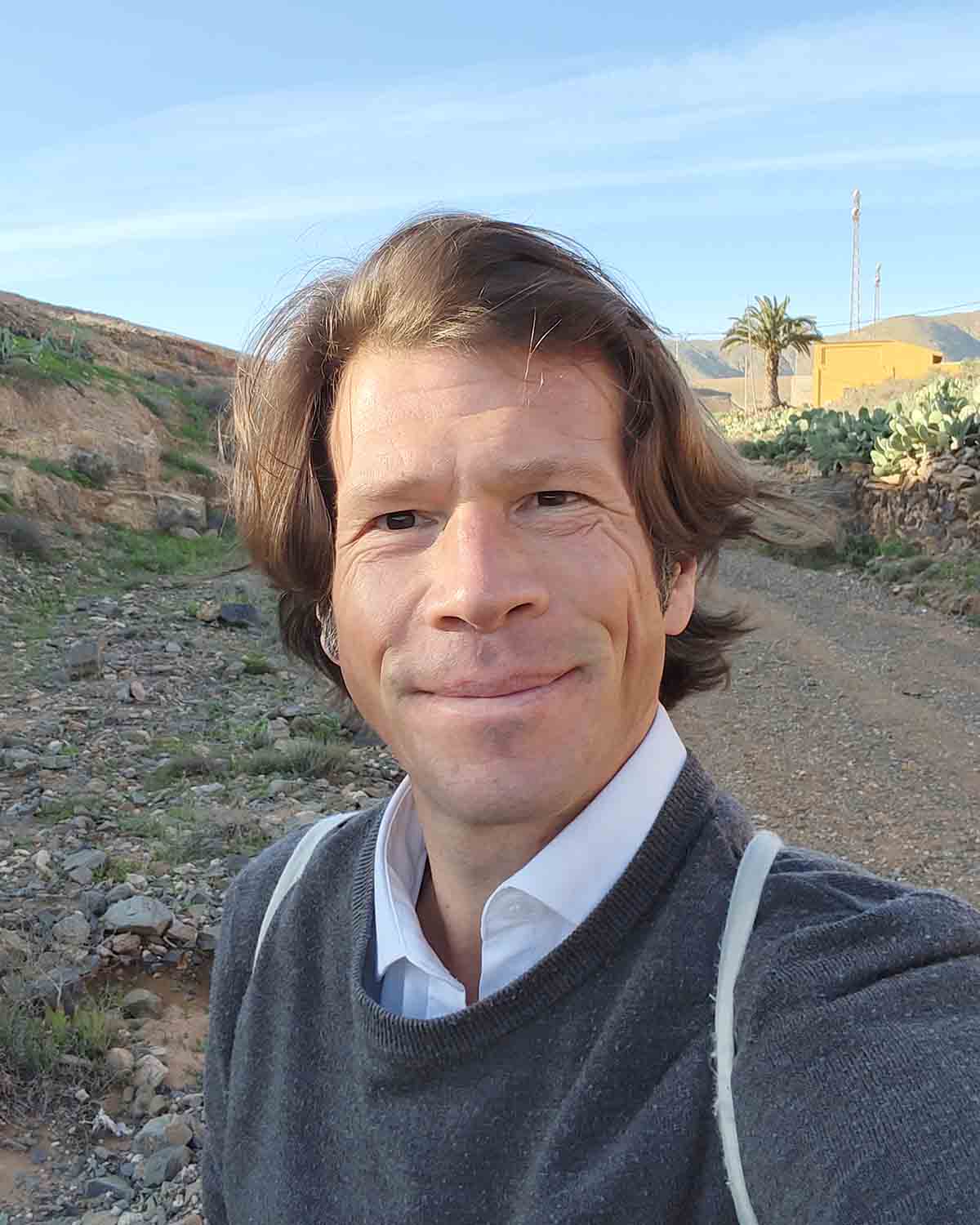
Dr. Thomas de la Fuente
An honest therapeutic encounter can be an invaluable starting point for personal transformation. I offer you the space for that — in English or German, in Linz or online, as a cognitive-behavioral therapist with a depth-psychological background.
A first glimpse
In this short video I talk about how I understand therapy and what you can expect from working with me. You can find more videos on this page.
What people most need in difficult times is rarely advice. It is someone who stays. Thomas de la Fuente
What to expect
Most people who come to therapy bring something they have been carrying for a while — sometimes for a very long time. I don't try to explain what is "wrong" with you. Instead, I find out together with you what needs to change and what can support your development.
Cognitive-behavioral therapy is evidence-based and focused on visible progress — we work concretely on what you want to address and check whether the approaches we apply are actually working. At the same time, it often becomes clear in the course of therapy that symptoms don't always arise where they become visible. My decades-long engagement with psychodynamic theory helps me look beyond recurring patterns with you, without losing sight of the concrete. In practice, this means clear structure and useful tools — combined with a willingness to look wherever things get more complicated. No dogmatic loyalty to one school, but an invitation to examine together what works for you.
The therapeutic relationship is for me not merely the framework of the work — it is also an indirect goal and the site of change. In our sessions I pay attention not only to what is being said, but also to what you cannot yet put into words. And then we find a language together for things that may have been troubling you for decades. So that it can become lighter, freer — and, if you are ready to allow it for yourself, genuinely different.

Personal background
Born in Wetzikon, Switzerland; raised between Basel and Upper Austria; several years lived and worked in the United States. This biography left two traces that come together in the therapeutic work: an easy fluency in both German and English — both at near-native level — and an early-sharpened sense of how strongly cultural context shapes psychological experience.
From 2002: studies in philosophy at the University of Vienna and the Medical University of Vienna, with a focus on depth psychology (MA, with distinction). Doctorate at the University of Vienna (PhD, with distinction) — the dissertation examined Erik Erikson's concept of identity and its migration into product and brand culture.
There followed years in global corporate communications, with travel across several continents and the deepened experience of how differently people think, feel and encounter the world. The path to becoming a practising psychotherapist was long and winding. But it was precisely these detours — through philosophy, psychoanalysis, cultural history, and a decades-long preoccupation with the question of what sustains people — that gave me a perspective I draw on daily in clinical work.

Academic & clinical
Psychotherapy training
- Registered psychotherapist (behavioral therapy) — entered in the official Austrian register of psychotherapists (Berufsliste Psychotherapie, Federal Ministry of Health) (2026)
- MA (Psychotherapy Science) — Sigmund Freud Private University, Vienna. Specialization: cognitive-behavioral therapy (2026)
- BA (Psychotherapy Science) — Sigmund Freud Private University, Vienna (2023)
- Clinical work since 2024
Academic
- PhD (Philosophy) — University of Vienna, with distinction (2011). Dissertation: "Selling Identity." Supervisor: Prof. Alfred Pfabigan
- MA (Philosophy) — University of Vienna & Medical University of Vienna, with distinction (2007). Focus: depth psychology, psychoanalytic foundations
Professional memberships & continuing education
- Member of the Austrian Federal Association for Psychotherapy (ÖBVP)
- Ongoing supervision, peer consultation, and continuing education in schema therapy and CBT
Languages
- English — near-native; several years lived in the United States
- German — native
- Spanish — basic
Research & tools
Out of an engagement with the therapeutic relationship has grown the FIRA Assessment — a novel instrument for the qualitative characterization of therapy relationships, currently being trialed in clinical and academic contexts.
When off duty ...
I have been a runner for many years — sometimes for the joy of it, sometimes to clear my head, sometimes simply because the silence outdoors has a different quality from the silence indoors. On Fuerteventura, where I have a second home, I find both: a landscape that breathes and an expanse that organises thought. The quiet power and austerity of the island let you sense who you are when you strip away all the ornamentation.
I read widely — psychoanalysis and philosophy, but new technologies have also caught my attention. Relevant podcasts accompany me on walks. And I value conversations that need time and that don't stop just where they're getting truly interesting. What occupies me outside the practice naturally feeds into the work — and vice versa.